Dance and costume
Mongolian dance: biyelgee and the deel
Biyelgee began inside the ger and is danced with the upper body. What it expresses, how each people dances it, what a deel is and where contortion fits.
Book the Ulaanbaatar show ↗Dance made for a small space
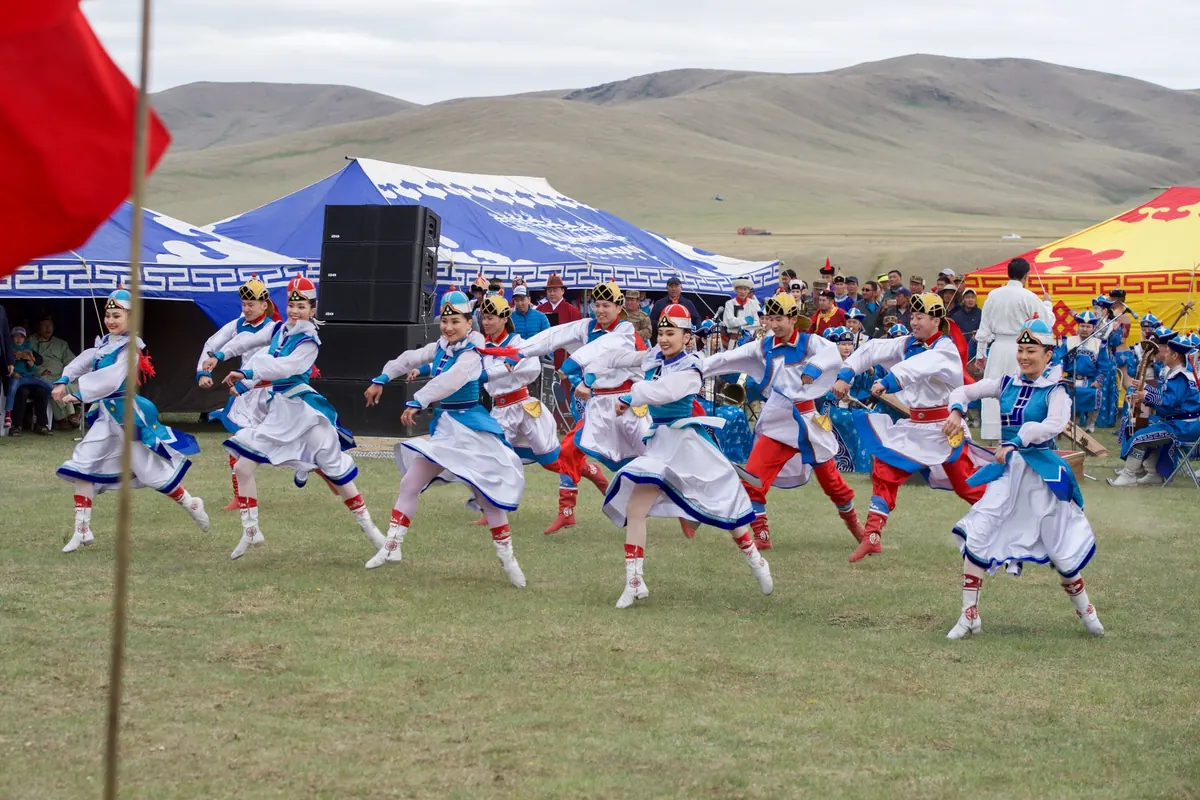
Biyelgee is the dance UNESCO calls the original forebear of Mongolian national dances. It comes from nomadic life and is typically confined to the small space inside the ger, performed half sitting or cross-legged. That shapes everything about it. Because there is no room to travel, the dancers use hand, shoulder and leg movements, and the upper body does most of the talking. When you see Mongolian dancers on a large stage, look for that upper-body vocabulary underneath the bigger movement.
What the hands and shoulders say
The movements express daily life. UNESCO lists household labour, customs and traditions and spiritual characteristics tied to different ethnic groups, and other accounts name milking, cooking and hunting. Biyelgee dancers wear clothing and jewellery with colours, patterns and embroidery specific to their people and community. The dances play a part in family and community events such as feasts, celebrations and weddings, and they stress family unity and understanding among Mongolia's ethnic groups.
Each people dances its own
There is no single biyelgee. UNESCO places the dance with performers from several ethnic groups in the Khovd and Uvs provinces, and each group has its own form. The Bayid dance with their knees bent outwards, balancing mugs of sour mare milk on them, and the Dörvöd balance such mugs on their heads and hands. The Zakhchin squat and lean forward, and the Buryat dance in a circle, always moving in the direction of the sun. Costume and gesture tell you which tradition you are watching.
- Bayid: knees bent out, a mug of airag balanced on them
- Dörvöd: mugs balanced on the head and hands
- Zakhchin: dancers squat with the body leaning forward
- Buryat: a circle dance that follows the sun
Music for it
The usual accompaniment is the tovshuur, a plucked lute, the morin khuur and the ikhel, sometimes with other instruments. Some dances, such as the Buryat yohor, are danced to voices alone. In western Mongolia, the morin khuur also accompanies a dance in triple time that is a little like a waltz, with movements that imitate the daily tasks of a nomad family.
Why UNESCO lists it as endangered
Biyelgee is on UNESCO's list of heritage in need of urgent safeguarding, inscribed in 2009. The reasons given are plain: most of the people who pass the dance on are elderly and their numbers are falling, and few representatives remain of the distinct forms of the different groups. Traditionally the dance is taught by apprenticeship or at home, within a family, clan or neighbourhood. A stage programme keeps its look alive, though it cannot replace that transmission.
What a deel is
The deel is the traditional Mongolian garment, made of cotton, silk, wool or brocade. It has no buttons down the centre; the sides are drawn across the body, with the left flap covering the right and fastening with clasps on the right side. A large sash, usually silk, is worn at the waist, and the space between the flaps above the belt forms a big pocket. Both men and women wear it. Ceremonial deels, for weddings and holidays, have silk outer layers.
Reading the costumes
Deels differ between peoples and periods. The Khalkha deel has round edges at the chest opening, and the Buryat deel has square ones. They come in many colours, most often blue, olive or burgundy. In a hall, watch the collar, the line of clasps on the right and the sash. Nothing needs memorising, but one detail noticed makes the whole costume easier to read.
Where contortion fits
A stage show that mixes dance and contortion is following a Mongolian habit. Accounts of Mongolian contortion link it to dance and to Buddhist training of body and mind, and the Mongolian State Circus has been the main route into professional training. Its history is told in different ways, so this guide gives no date for it. What you will see on stage is the result: strength and flexibility, set against music that often moves slowly.
Sources